Pretty Isn’t the Only Thing a Garden Can Be
A garden can make you look, but scent, sound, touch, movement, curiosity, and one good place to stay make it somewhere worth living in.
Flowers photograph beautifully.
So does interesting foliage, a perfectly placed tree, a freshly edged bed and that one corner of the garden that somehow looks much better through a phone than the rest of the yard.
We notice color.
We consider shape.
We stand back and decide whether the composition works. We take seventeen pictures of a rose because sixteen of them somehow failed to capture what we are seeing. Then we post the good one.
None of this is wrong. Gardens are visual places, and making one beautiful is a perfectly respectable obsession. But there is a problem with designing a garden primarily for your eyes. Your eyes are only one of the ways you live there.
A garden can smell incredible.
It can sound different from the rest of the yard. It can brush against your arm. It can make you slow down because the path narrows.
It can hide something until you turn a corner. It can give you one chair where the afternoon feels inexplicably better. It can contain a plant you would never photograph but would absolutely notice if somebody removed it.
Pretty is good.
Pretty just isn’t the whole job.
Some of the best plants barely photograph at all
There are plants that understand Instagram.
A peony understands Instagram.
A dahlia definitely understands Instagram.
A perfectly backlit Japanese maple has probably considered becoming an influencer.
Then there is thyme.
Thyme is not particularly concerned with your content strategy. Brush your hand across it, though, and suddenly the plant has an entirely different argument to make. The same thing happens with rosemary, lavender, scented geraniums and plenty of other aromatic plants whose leaves become more interesting when you interact with them.
Fragrance changes how you experience distance too. A flower can announce itself before you see it. A shrub around a corner can tell you it’s blooming without requiring an introduction.
A plant beside the front door can become something you register every single time you come home.
That’s design.
The Royal Horticultural Society recommends placing fragrant plants where their scent can actually be encountered, including near entrances, paths and seating areas. Sheltered spaces can also help hold fragrance rather than allowing it to disappear immediately into moving air.
Which raises an obvious question.
Why do we so often put the best-smelling plant at the back of a border? If nobody ever gets close enough to smell it, we’ve basically hung perfume on the wall.
Put the experience where the person is
Garden design sometimes begins from a strange perspective.
We stand at the patio.
We look outward.
We arrange the view.
But that’s only one position in the garden.
Walk through it.
Where do you actually stop?
Where do you turn?
What do you brush against?
Where do you open a gate?
Where do you sit?
Which path do you use when carrying groceries? Where does someone lean during a party when all the chairs are taken?
These are not glamorous questions.
They’re also where a garden becomes personal. If there is a fragrant plant you adore, put it somewhere your life intersects with it.
Near the chair.
Beside the path.
Outside the window you open.
Near the gate you touch twice a day. Penn State Extension describes fragrance as another dimension of garden design alongside scale, form, texture and color, and recommends using fragrant plants to create moments that invite people to linger.
That word matters.
Linger.
A beautiful garden can make somebody look. A good garden can make somebody stay.
Your garden is already telling you where to go
Every garden has a choreography whether you planned one or not.
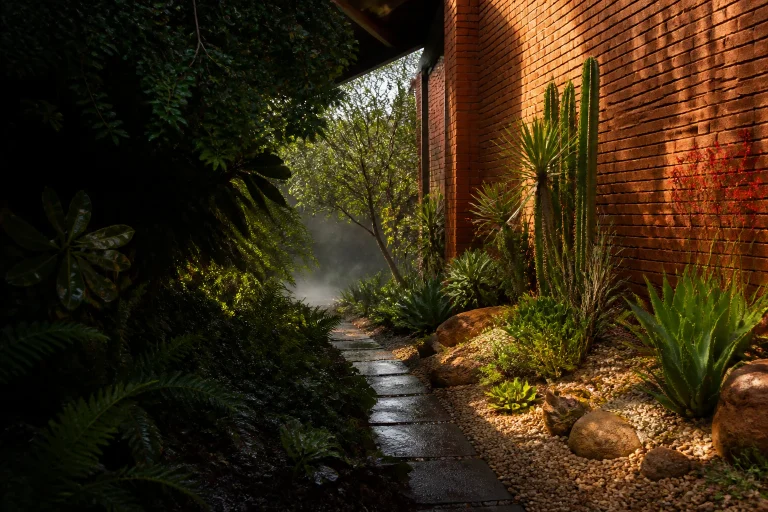
A wide path says move.
A narrow path says pay attention.
A bench says stop.
A gate says something changes here. A low branch makes you duck. A stepping stone asks you to place your foot.
An opening in a hedge makes you curious about what’s beyond it. Once you notice this, garden design becomes much more interesting than arranging attractive plants around the perimeter of a property.
You can reveal things slowly.
Maybe the best plant isn’t visible from the house. Maybe you have to walk toward it. Maybe a fragrant shrub announces the next part of the garden before you reach it.
Maybe one path gets narrower before opening into the seating area. Maybe the prettiest view is deliberately not the first one. A little withholding can be very attractive.
The garden does not have to give everything away from the patio.
Sound counts
Close your eyes in a garden and it does not disappear.
Hopefully.
Leaves move.
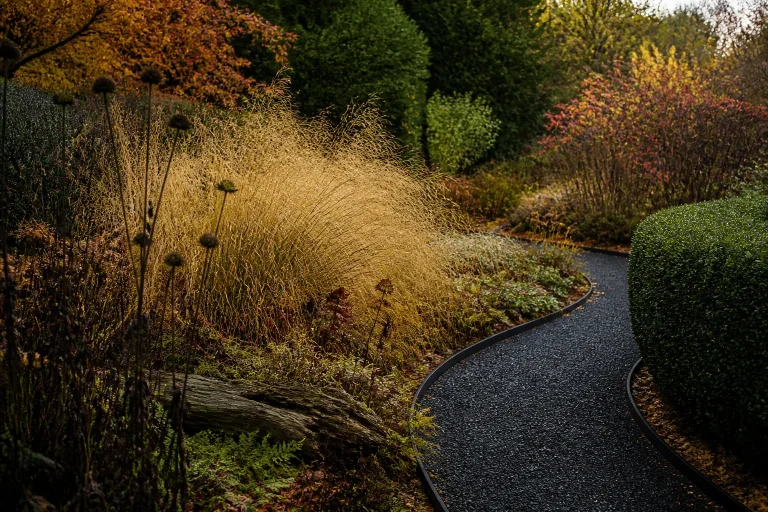
Grasses rustle.
Bees conduct extremely serious business.
Birds argue about property.
Water, if you have it, changes the atmosphere completely.
Even gravel underfoot contributes something.
The Royal Horticultural Society includes sound and plant movement among the elements that can shape a sensory planting experience. You don’t need to install a waterfall. Please don’t interpret this as permission to buy a plastic waterfall.
Start with what the garden already sounds like. A hedge can soften what comes from beyond it. Tall grasses can make wind visible and audible.
A tree canopy creates a different feeling from an exposed patio. A small fountain can mask some background noise, but so can the simple effect of giving your ears something closer and more pleasant to notice. And sometimes silence is the feature.
If one corner of your yard is noticeably quieter than another, that may be where the chair belongs.
Touch is allowed
We spend a surprising amount of time designing gardens that look as though nobody should enter them.
Perfect border.
Perfect mulch.
Perfect little plant labels.
Please admire from a respectful distance.
But plants have texture.
Some leaves are soft.
Some are glossy.
Some are leathery.
Some are feathery.
Some grasses move through your fingers. Some herbs release fragrance when touched. Sensory planting deliberately uses those differences to encourage closer interaction with plants rather than treating the garden solely as something to observe.
That doesn’t mean grabbing unfamiliar plants. Some plants irritate skin. Some have thorns, spines or toxic parts. Know what you’re growing before turning your border into a petting zoo. But with plants you know are appropriate to handle, touch can be part of the experience.
Put the soft thing close enough to touch. Let the rosemary reach slightly toward the path. Allow the grass to move where you can actually see it move.
Not everything needs to behave like it’s behind velvet rope.
Scent needs editing too
There is one danger here.
Once you discover fragrance as a design element, you may decide you need all of it.
Rose.
Jasmine.
Lavender.
Gardenia.
Lilac.
Daphne.
Something citrusy.
Something spicy.
Something called Chocolate Cosmos because obviously now we have questions.
Calm down.
Scent has relationships just like color does. A fragrance can be wonderful by itself and overwhelming beside another strong fragrance. And scent doesn’t remain politely inside the physical outline of a plant.
It travels.
That makes placement important.
One strongly fragrant plant near a seating area can create a moment. Six competing fragrances around the same chair can create the botanical equivalent of walking through the perfume department. You are designing an experience, not duty-free.
Make somebody curious
There is another sense we don’t talk about much in garden design.
Curiosity.
Technically, no, it isn’t one of the five.
I’m keeping it.
A garden becomes more interesting when you can’t understand the entire thing in three seconds.
This doesn’t require acreage.
A shrub partially obscuring a chair can do it. So can a path disappearing behind planting. A container positioned just beyond the immediate view.
A small opening.
A change in paving.
A plant you smell before you see.
The effect can be tiny.
What matters is that something makes you move. This is the difference between looking at a garden and entering one. You don’t have to make the place confusing. Nobody should need breadcrumbs to get back to the kitchen.
Just resist the urge to explain everything immediately. A garden can have a little suspense.
Give one place a reason to exist
This is where a lot of outdoor spaces get strangely vague. There’s a patio because houses have patios. There’s a chair because patios have chairs.
There’s a plant beside the chair because we garden.
Fine.
But why would you actually sit there?
Give the spot something.
Morning sun.
Afternoon shade.
A fragrant plant.
The sound of grasses.
A view through another planting.
A place where hummingbirds regularly appear.
A little privacy.
A ridiculous rose you want to inspect every day. It doesn’t have to be grand. It just has to reward you for being there.
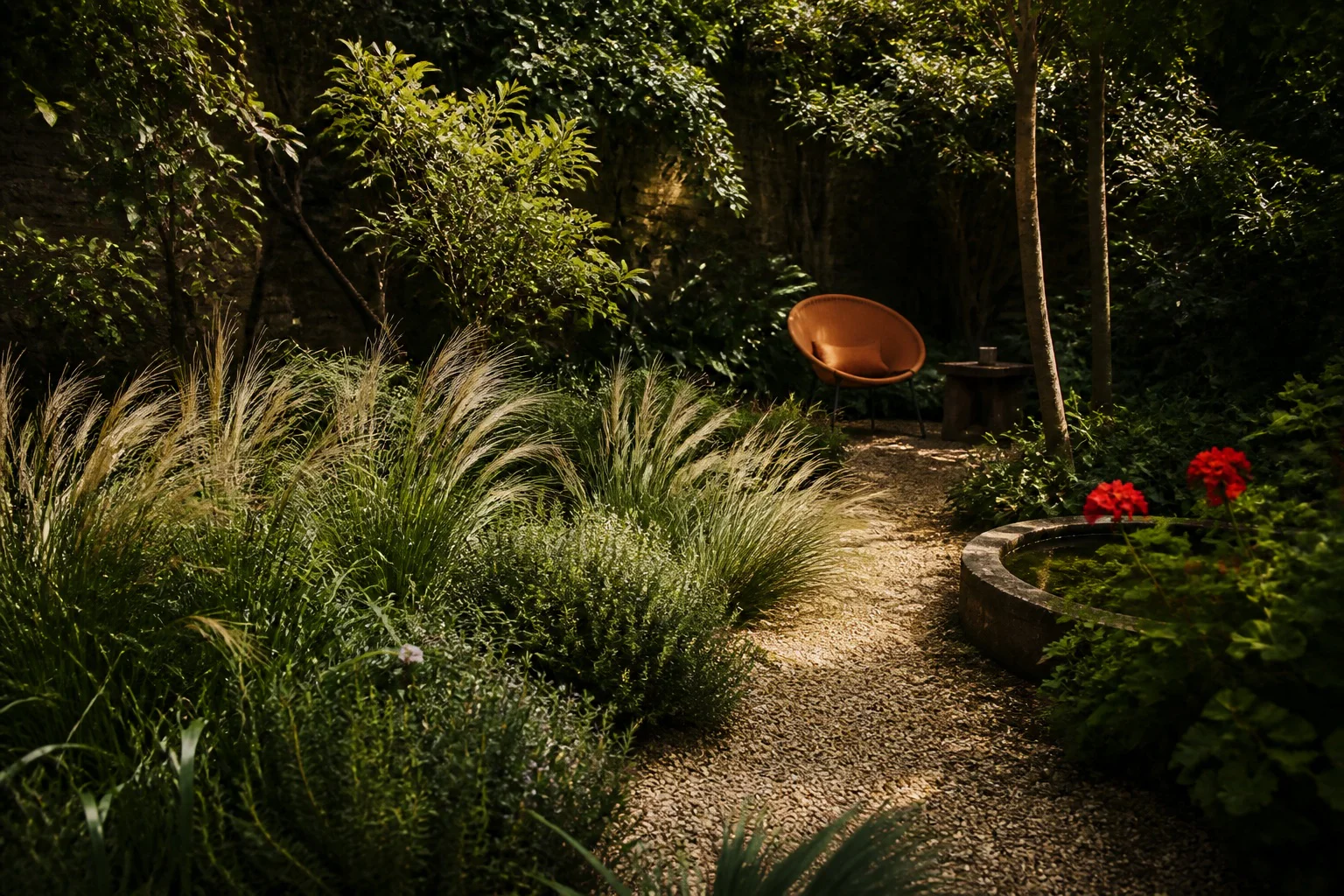
And this is where designing from inside the garden instead of outside it changes things. Stand where the chair actually is.
Sit down.
What do you see from there?
What do you hear?
Does anything smell good?
Do you feel exposed?
Are you staring at the air-conditioning unit? We spend a lot of time asking whether a chair looks right in a garden. Perhaps the garden should occasionally be asked whether it looks right from the chair.
Not everything beautiful needs to announce itself
There is a kind of garden beauty that photographs beautifully. And there is another kind that barely survives a photograph at all. The smell when you open the gate.
The sound when wind moves through a particular plant. The texture of an herb you touch without thinking. The cooler patch of shade beneath a tree.
The few seconds when you walk through a narrow passage and the rest of the yard disappears. The chair everyone eventually ends up sitting in. These things don’t make particularly impressive thumbnails.
Good.
The internet already has plenty of beautiful gardens. Your garden gets to be somewhere you actually live.
So keep choosing beautiful plants.
Obsess over the color if you want to. Move the pot three inches to the left and then move it back.
We support this behavior.
But every once in a while, put the phone down and walk through the place without looking for the picture.
Listen.
Touch something you know is safe to touch. Notice where the air smells different. Notice where your body slows down.
Notice what makes you turn.
Notice what makes you curious.
Notice where you want to stay. A garden doesn’t become less beautiful when you stop designing it exclusively for the eye.
It becomes harder to photograph.
And much more interesting to be in.
Sources and further reading
- Royal Horticultural Society on Fragrant Plants
- Royal Horticultural Society on Sensory Garden Plants with Scented Foliage
- Royal Horticultural Society on Plants with Movement in the Breeze
- Royal Horticultural Society on Wellbeing Garden Blueprint
- Penn State Extension on Fragrant Trees and Shrubs
- University of Florida IFAS Extension on Sensory Gardens