Maybe the Garden Doesn’t Need to Be This Clean
A cared-for garden can keep clean paths and strong edges while leaving useful seedheads, stems, leaves, and habitat where they belong.
There is a particular kind of satisfaction in cleaning up a garden.
The leaves are gone.
The spent flowers are gone.
The brown stems are gone.
The path has been swept.
The beds have been edged.
The mulch has been smoothed into submission. You stand back and admire your work.
Nothing out of place.
Nothing dying.
Nothing decomposing.
Nothing apparently living there either.
We have developed some very strange ideas about what a cared-for garden is supposed to look like. Apparently, it should contain thousands of living organisms while displaying almost no evidence that living things are actually happening. Leaves should fall, but preferably disappear immediately afterward.
Flowers may bloom, but once they fade they are expected to leave the premises. Stems may turn brown, but only briefly.
Moss is suspicious.
A mushroom requires an investigation.
And heaven help the perennial that has the audacity to die back somewhere visible. There is nothing wrong with liking a tidy garden. I like a clean edge as much as the next homosexual.
But perhaps we have confused care with cleanliness. They are not quite the same thing.
Nature has terrible housekeeping
Go somewhere plants are growing without us.
Nobody has raked.
Nobody has deadheaded.
Nobody has blown the leaves into a pile and then become strangely territorial about whether the neighbor’s leaves are crossing the property line.
Things fall.
Things dry.
Things break.
Things decompose.
Seeds sit on dead stalks.
Leaves collect beneath shrubs.
Insects disappear into places we would probably clean if given the opportunity. And somehow the entire system keeps going.
A garden obviously isn’t wilderness.
We choose plants. We make paths. We prune things. We remove things. We decide where the chair goes. That’s part of what makes it a garden. But somewhere between wilderness and a hotel lobby is probably a useful amount of mess.
Deadheading is not a moral obligation
A faded flower can create an almost irresistible urge.
Remove it.
Sometimes that’s exactly the right thing to do. Deadheading can encourage additional flowering in many plants and prevent unwanted self-seeding. But not every finished flower needs immediate intervention.
The Royal Horticultural Society recommends leaving plants that produce ornamental seedheads, useful fruits or seeds eaten by birds, as well as plants you want to self-seed. That means a flower doesn’t necessarily stop contributing when the petals disappear. It may simply have changed jobs.
A coneflower seedhead isn’t a failed coneflower. An ornamental grass turning tan isn’t an emergency.
A stalk can become architecture.
Seeds can become food.
A hollow stem can become shelter. And sometimes the dead version of a plant is genuinely beautiful. RHS notes that perennial seedheads and hollow stems can provide winter food and shelter for birds, insects and small animals while also contributing structure to the garden.
The trick is looking before cutting.
Does this still have shape?
Does it add something?
Is something using it?
Or has it collapsed across the path like it had a difficult evening?
That one can go.
Leaves are allowed to stay on the property
Leaves have terrible public relations.
The tree spends months manufacturing them.
They shade the ground.
They feed the tree.
They turn beautiful colors.
Then they fall and suddenly we’re treating them like somebody dumped trash in the yard. To be clear, there are perfectly good reasons to move leaves. A thick layer can smother lawn.
Wet leaves can make paths slippery.
Leaves can clog drains.
Nobody is asking you to convert the front walkway into a woodland floor. But moving leaves is different from removing every leaf from the property. Illinois Extension recommends leaving some leaves in garden beds, where they can insulate overwintering insects and eventually decompose and return nutrients to the soil.
RHS similarly suggests leaving some fallen leaves beneath shrubs rather than removing everything, providing places where birds can forage for overwintering invertebrates. So rake the lawn if it needs raking.
Clear the walkway.
Find the drain.
Then perhaps move some of what you collected underneath shrubs or into another appropriate part of the garden. The leaf does not need to enter witness protection simply because it fell off the tree.
The mess needs a frame
This is where things get interesting. Because there really is a difference between This garden has been intentionally allowed to loosen
and
Nobody has dealt with this yard since 2019. Sometimes the difference is surprisingly small.
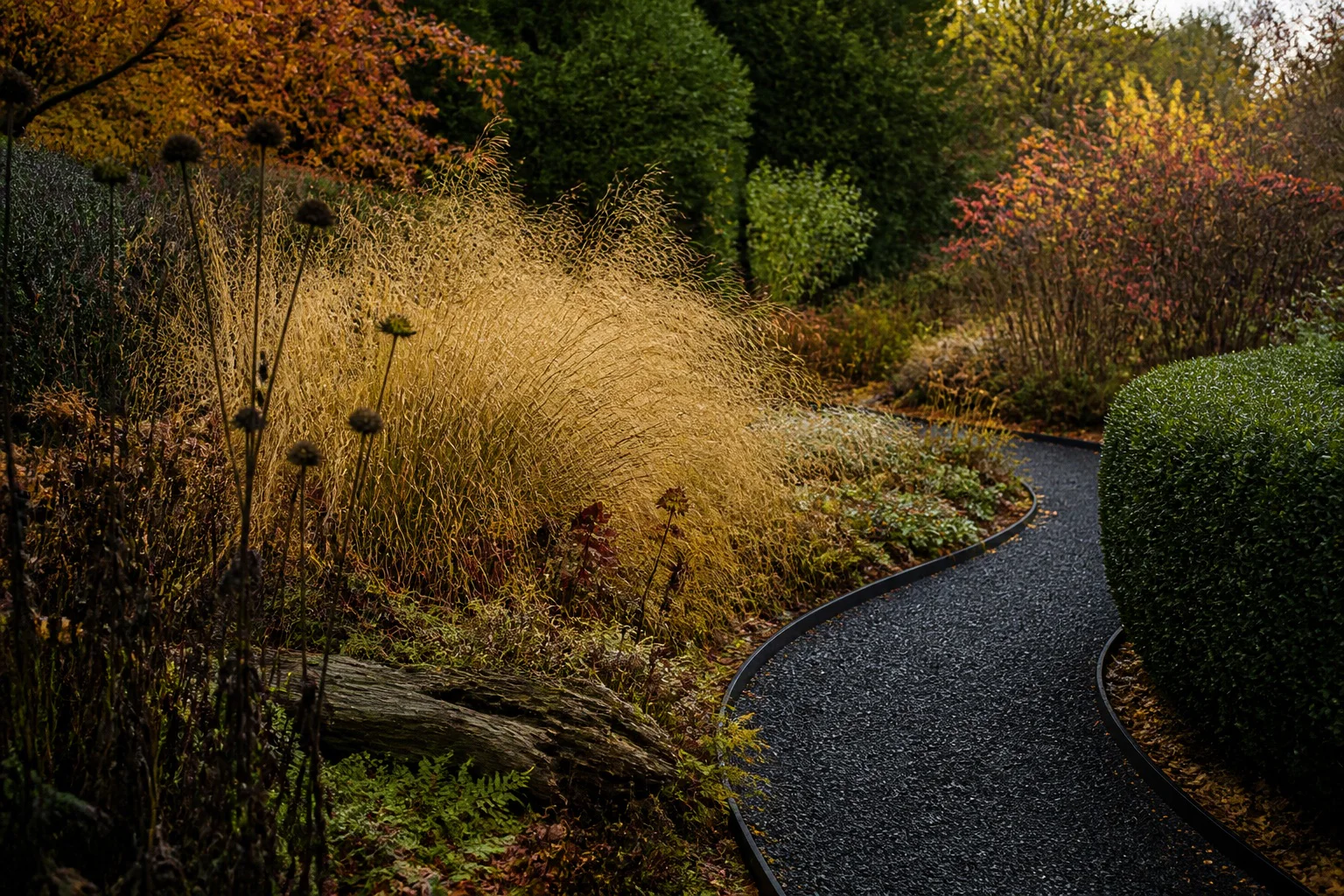
A clean edge.
A visible path.
A clipped hedge beside a loose planting.
One deliberate container.
A bench.
A defined opening.
A little repetition.
Penn State Extension recommends exactly this kind of approach when designing more natural residential landscapes. Borders, paths, fences and other recognizable garden elements can frame looser planting and communicate that the landscape is intentional and being cared for. I love this idea because it means the choice isn’t
formal garden or wildlife garden
tidy or wild
designed or natural.
Those are false choices.
You can have a beautifully edged path beside a slightly unruly planting. Actually, the contrast can make both look better.
The crisp part says
Yes, I know what’s happening here.
The loose part says
I’m choosing not to interfere with all of it. That’s a very different look from neglect.
If you’re going to leave something, leave the good stuff
This is not permission to become emotionally attached to every brown object in the yard.
Some plants die beautifully.
Others collapse into beige oatmeal.
Learn the difference.
An ornamental grass that remains upright and catches low light might deserve several more months. RHS recommends leaving the foliage and seedheads of many deciduous ornamental grasses through winter because they provide structure and movement, with the added benefit of food and shelter for wildlife. A blackened perennial lying face-down across another plant may have completed its contribution.
Edit.
Keep the stems that still create interesting lines.
Keep seedheads with shape.
Keep leaves where they’re useful and unobtrusive. Remove things that are diseased, hazardous, invasive, blocking circulation or genuinely detracting from the garden. The goal is not to prove how environmentally enlightened you are by refusing to touch anything.
The goal is to stop assuming that brown automatically means bad.
Wildlife has inconvenient taste
Here is the slightly annoying part. Wildlife often prefers exactly the things we’re most eager to remove.
Hollow stems.
Seedheads.
Leaf litter.
Longer grass.
Dead wood.
Dense shrubs.
RHS recommends leaving dead plant stems for overwintering insects and allowing some plants to go to seed, while its bird guidance encourages leaving seedheads, scattered leaves, twigs and some areas of longer grass. Illinois Extension similarly notes that some native bees nest in hollow stems and that butterflies and moths may overwinter among fallen leaves and plant material. Unfortunately, nobody appears to have informed them about our aesthetic standards.
This does not mean your entire yard needs to become habitat. It means habitat can exist in degrees. Maybe one bed gets cleaned later.
Maybe leaves stay underneath the shrubs but not on the patio. Maybe some seedheads remain and others go. Maybe the back corner is allowed to be considerably looser than the entrance.
A garden doesn’t have to choose one philosophy and apply it equally to every square foot. Rooms don’t work that way either.
Neither do outfits.
Neither do people.
Leave one thing longer than you normally would
If all of this sounds suspiciously like I’m asking you to make the yard messy, don’t start with the entire yard.
Pick one thing.
Leave the ornamental grass standing.
Don’t deadhead one group of coneflowers. Let some leaves remain beneath the shrubs. Delay cutting back one perennial bed.
Then watch.
Does it still look good?
Does frost improve it?
Do birds visit it?
Does anything emerge from it later? Does it begin looking terrible in February?
Fine.
Cut it then.
Gardening doesn’t require ideological purity.
You are allowed to change your mind. In fact, this might be a better way to discover your tolerance for looseness than deciding overnight that you are now a Wild Gardener and terrifying the homeowners association.
Start with one thing.
See what happens.
There should still be somewhere to put your foot
Naturalistic does not mean inconvenient.
Keep paths usable.
Keep entrances clear.
Don’t let thorny plants attack visitors because you’ve decided boundaries are oppressive.
Remove dangerous branches.
Manage plants that spread where they aren’t wanted.
Deal appropriately with diseased material.
Keep sight lines clear where safety requires them. And control invasive plants rather than allowing “wild” to become an excuse for letting them spread. Penn State’s recommendations for natural residential landscapes still emphasize borders, management, appropriate plant selection and controlling invasive species.
A functioning garden still needs a gardener. Maybe just one who knows when not to garden.
Let decomposition happen somewhere
This may be the least glamorous sentence ever published on GardenGay. Something in your garden should probably be rotting.
Not the deck.
Let’s be specific.
Leaves.
Wood.
Old plant material.
Compost.
Organic matter doesn’t disappear when it finishes looking pretty.
It becomes something else.
That process is one of the basic engines of a garden. We tend to celebrate growth and become uncomfortable with everything on the other side of it.
The new leaf is beautiful.
The fallen leaf needs a bag.
The flower is beautiful.
The seedhead needs clippers.
The living stem belongs in the garden. The dead stem belongs somewhere else. But gardens don’t actually work in that straight line.
They loop.
Growth becomes decline.
Decline becomes material.
Material becomes habitat or soil.
Then something grows again.
You don’t need to display every stage prominently beside the front door. But allowing some of that cycle to happen inside the garden makes sense.
Maybe care looks different than we thought
There will always be gardens that are clipped, polished and immaculate.
Some of them are spectacular.
There will also be gardens overflowing with plants, insects, seedheads and things nobody remembers planting. Some of those are spectacular too. GardenGay is suspicious of any standard that mistakes tidiness for virtue.
The interesting place is somewhere between them. A garden where the path is swept but leaves remain beneath the shrubs. Where the edge is deliberate but the planting behind it gets to move.
Where a beautiful seedhead isn’t removed simply because the flower finished. Where one area can be polished and another allowed to loosen. Where wildlife gets a few places that aren’t immediately cleaned out from underneath it.
Where you can tell somebody cares deeply about the garden precisely because they haven’t controlled every inch of it.
So yes.
Edge the path.
Prune the hedge.
Move the pot three times.
Pull the invasive thing.
Sweep the patio.
Have standards.
Just maybe stop asking every square foot of a living garden to look freshly vacuumed. A little mess is not the opposite of care. Sometimes it’s evidence that the garden is doing something.
Sources and further reading
- Penn State Extension on Neighborly Natural Landscaping in Residential Areas
- Illinois Extension on Consider Pollinators During Fall Garden Cleanup
- Royal Horticultural Society on Deadheading Plants
- Royal Horticultural Society on Spectacular Seedheads for Winter Interest and Wildlife
- Royal Horticultural Society on Five Ways to Help Birds in Every Season
- Royal Horticultural Society on Wildlife in Gardens