Your ZIP Code Doesn’t Know Your Garden
Hardiness zones give you a baseline. Your walls, shade, wind, drainage, and sheltered corners decide what plants experience in the exact place they grow.
Your garden has an official climate.
Very organized of it.
There is a hardiness zone.
There is an average first frost. There is an average last frost.
There is a rainfall number.
There is probably an app prepared to tell you exactly what the weather is doing within a ten-mile radius. Unfortunately, nobody appears to have briefed the strip of soil beside the west-facing wall, which is operating approximately three zip codes closer to hell. That is the problem with gardening by category.
GardenGay has a healthy suspicion of categories that confuse a useful shorthand with the whole truth.
Zone 8.
Full sun.
Part shade.
Drought tolerant.
Six hours of light.
Useful information.
Also incomplete.
Your plants are not growing in a zone. They are growing in the exact patch of dirt where you put them. And that patch of dirt has opinions.
The Yard Is Not One Place
Walk twenty feet across almost any property and something changes.
The light changes.
The wind changes.
The soil stays wetter.
The soil dries faster.
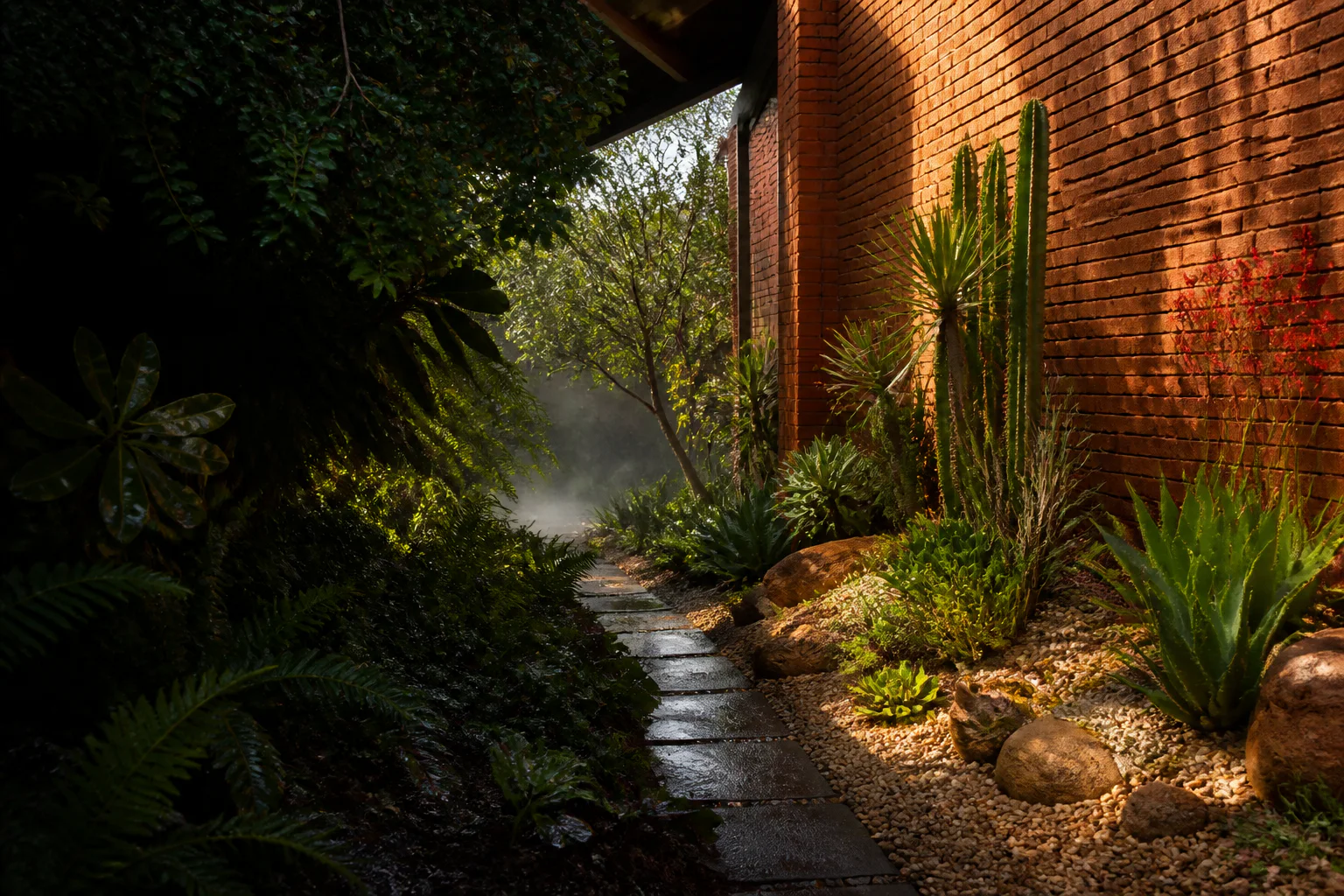
A wall reflects heat.
An overhang blocks rain.
A fence interrupts cold air.
A tree canopy changes both temperature and moisture. One part of the yard may thaw early. Another can remain cold and damp long after everything around it has moved on.
University of Minnesota Extension describes microclimates as places within the same landscape where wind, light, moisture and temperature differ from the surrounding area. That means your backyard may technically have one address and several climates.
Which explains quite a lot.
The plant thriving near the house is not necessarily stronger than the identical plant struggling six feet away. It may simply have a better seat.
Meet the Oven
Every yard seems to have one. The place where the sun hits hard.
The wall gets hot.
The soil dries before everything else.
You water.
It dries again.
You begin taking this personally.
Buildings, pavement and exposed areas can create warmer microclimates, while intense sunlight combined with limited cooling wind can make one part of a landscape significantly hotter than another. University of Minnesota Extension specifically identifies areas with intense sun and little cooling wind as warmer microclimates. And afternoon sun deserves special attention.
Morning sun and afternoon sun may both technically count toward the same number of hours, but they do not feel the same to a plant. Afternoon exposure often arrives with higher air temperatures and much stronger heat. So when a tag says full sun, that does not automatically mean every full-sun location on the property is interchangeable.
Six hours beside a reflective wall at 4 p.m. can be a very different experience from six hours in an open bed that gets most of its light before lunch. Sometimes the plant is not failing full sun. It is failing your particular version of full sun.
Then There’s the Refrigerator
At the opposite end of the property lives the place where spring seems reluctant to arrive.
It stays damp.
It stays cool.
Maybe frost lingers there.
Maybe snow, where applicable, disappears later. Maybe a plant that should have started growing two weeks ago is still considering its options. Shade can create cooler microclimates, and lower areas can collect colder air.
Oregon State Extension notes that cold air moves downhill and can settle in low areas, producing frost pockets. This can happen on a surprisingly small scale.
A dip in the yard.
The bottom of a slope.
A spot where a solid fence interrupts air movement. The coldest place on your property may not be very far from the warmest one.
Which feels unnecessarily dramatic.
But gardens enjoy range.
The Bed That Somehow Never Gets Rain
This one can make a gardener feel slightly insane.
It rains.
Everything is wet.
Except the plant beside the house.
Again.
Large roof overhangs, eaves, foundations, tree canopies and other structures can prevent rainfall from reaching soil even when the surrounding garden receives plenty. University of Minnesota Extension describes this as dry shade and notes that buildings and overhangs can create areas deprived of both light and rainfall. This matters because we sometimes blame the plant.
Then the irrigation.
Then the soil.
Then ourselves.
Meanwhile, the roof has been quietly holding an umbrella over the bed for six years. Stand there during an actual rainstorm sometime. You may learn more in five minutes than you did from three weeks of watering schedules.
The Wind Machine
Some parts of a garden seem personally offended by lightweight furniture.
Pots tip.
Leaves dry.
Tall plants lean dramatically.
You sit down and immediately reconsider. Wind is another part of microclimate that gardeners often notice only after something has gone wrong. Oregon State Extension recommends observing wind direction alongside sun and shade when planning a garden, particularly in exposed climates.
But you do not need to live beside the ocean to have a wind problem.
Buildings can funnel air.
Open side yards can become wind corridors. A gap between structures can create a remarkably enthusiastic breeze. Trees, shrubs, fences and other windbreaks can alter what happens beyond them.
This can change more than whether your napkins remain on the table. Wind can increase moisture loss from plants and soil.
It can increase physical stress.
It can make one otherwise suitable location considerably less comfortable than another. The tag did not mention any of this. The tag had 18 square inches to work with.
The Suspiciously Nice Corner
Then there is the opposite problem. A plant survives somewhere it probably shouldn't. Maybe it's theoretically borderline hardy for your area.
Maybe every reference suggests it should struggle. Maybe you planted it years ago without knowing better and it has decided not to embarrass you. Do not ask too many questions.
But do observe.
Sites near buildings can sometimes stay warmer than more exposed locations. Oregon State Extension notes that areas close to structures may have warmer microclimates and that protected locations can affect cold exposure. A south-facing wall may collect warmth.
A sheltered courtyard may avoid some wind. An overhang may provide protection from certain weather while creating entirely different moisture problems. This is why gardeners occasionally get away with things.
Not because the hardiness map is wrong. Because the map is describing a region. Your plant is living beside a wall.
Your Zone Is Not Useless
Before we start disrespecting hardiness zones, they remain extremely useful. USDA hardiness zones describe average annual extreme minimum temperatures. That gives gardeners an important baseline for cold tolerance.
What they do not describe is everything else.
Heat.
Wind.
Rainfall.
Humidity.
Soil.
Sun exposure.
Drainage.
Cold-air drainage.
Reflected heat.
Protection from structures.
Summer drought.
And the strange little corner behind the garage where apparently anything goes. Oregon State Extension specifically warns that hardiness zones can oversimplify local growing conditions where multiple microclimates exist.
So use the zone.
Just don't ask it to do a job it was never designed to do.
Stop Reading the Yard From the Patio
One reason microclimates are easy to miss is that we tend to look at the garden from one or two familiar places.
Walk it differently.
Go outside in the morning.
Then again in late afternoon.
Notice where the shadows moved.
Go out on a windy day.
Find the calm spot.
Walk outside during rain.
Look beneath the overhangs.
After a cold night, notice which areas thaw first. After several hot days, put your hand near the soil in different beds. You are not conducting a scientific trial.
You are paying attention.
University of Minnesota Extension even recommends placing thermometers in different landscape areas and watching how temperatures change as the sun moves through the day. I love this because it turns something vague into something visible. You don't have to buy elaborate weather equipment.
A couple of inexpensive thermometers moved around the property can reveal that places separated by a surprisingly short distance are not experiencing the same day.
Give the Weird Places Names
This is where we can make ourselves useful. Map your garden according to what it actually does.
Not just
FRONT YARD
BACK YARD
SIDE YARD.
Give the problem areas names.
The Oven
The hottest, driest, most exposed place.
The Refrigerator
The spot that holds cold and wakes up late.
The Cave
Persistent shade.
The Wind Corridor
You already know.
The Umbrella
The bed that somehow misses the rain.
The Spa
Warm, protected, calm, suspiciously pleasant.
The Swamp
The place that stays wet long after everything else drains.
The Rebel
The corner where plants keep succeeding despite what every chart said should happen.
You don't need to actually label these in the garden.
Although I would respect it.
The point is to stop treating every planting area as interchangeable. Once you know the personality of a spot, plant selection becomes considerably easier.
A Struggling Plant Is Not Always Asking for More Care
This might be the most useful thing in the entire piece. When a plant struggles, gardeners tend to respond by doing things.
More water.
Less water.
Fertilizer.
Compost.
Pruning.
Spray.
Mulch.
A soil amendment somebody recommended online. A deeply concerned amount of staring. Sometimes one of those is correct.
Sometimes the plant is simply in the wrong place. The hydrangea getting blasted by afternoon heat may not need another product. The lavender sitting in damp shade may not need encouragement.
The plant drying beside the wall may not need a more complicated irrigation schedule.
It may need to move.
- sun
- heat
- wind
- rain exposure
- soil moisture
- competition
- cold protection
All at once.
We tend to think moving a plant means admitting defeat. I prefer to think of it as correcting the seating chart.
The Plant Tag Is a Starting Point
This is where gardening gets more interesting than following instructions.
A tag may say
FULL SUN.
You eventually learn which full sun.
It may say
MOIST, WELL-DRAINED SOIL.
You learn which bed stays moist and which one turns into concrete by July.
It may say
HARDY TO ZONE 7.
You learn that the protected corner behaves differently from the exposed side yard. This is knowledge nobody can fully package for you.
Not an app.
Not a gardening book.
Not GardenGay.
Because we do not live at your house.
You do.
That is your advantage.
Do Not Force the Garden to Agree With You
There is a slightly humbling stage in gardening where you realize the yard has been giving you information and you have simply declined to accept it.
The plant keeps scorching.
You keep replacing it.
The bed stays wet.
You keep installing plants that want drainage. The wind destroys the same tall perennial every year.
You stake it again.
At some point this becomes less gardening and more an argument. You do not have to win. If something repeatedly fails in one location, believe the location.
Put something there that actually likes what the place is offering. This may be less romantic than forcing the exact plant you imagined into the exact spot you imagined.
It is also considerably cheaper.
Let One Place Be Difficult
Not every microclimate needs fixing.
This is important.
You don't have to eliminate every windy spot.
Warm every cold corner.
Irrigate every dry bed.
Drain every damp area.
Sometimes the condition itself tells you what kind of garden belongs there.
Dry shade is difficult.
It is also a real condition with plants adapted to it.
A hot wall is challenging.
It can also become an opportunity for plants that appreciate heat. A damp low area may support things that would struggle elsewhere. A windy location may never become the place for delicate, top-heavy flowers.
Fine.
Gardening becomes easier when we stop trying to make the entire property behave the same way. Your yard does not need climate consistency.
It needs appropriate casting.
The Most Expensive Solution Isn’t Always the Right One
This is another reason to understand microclimates. We are very good at purchasing solutions.
Irrigation system.
Shade cloth.
Fertilizer.
Soil amendment.
Wind screen.
New plant.
Another new plant.
A much larger new plant because apparently size was the issue.
Sometimes those things are useful.
But before buying something, ask whether the problem changes ten feet away. If it does, you may not have a plant problem. You may have a location problem.
That is a much cheaper discovery.
Make a Map Nobody Else Can Make
The weather app knows your city. The hardiness map knows your region. The plant tag knows what usually works.
None of them knows about the brick wall beside your driveway. Or the strange cold pocket behind the shed. Or the afternoon wind that arrives every summer.
Or the place beneath the eaves that somehow misses every rainstorm. Or the protected little corner where you've been getting away with something horticulturally questionable for six years.
You know those things.
Or you can.
That may be one of the most valuable differences between knowing about plants and knowing a garden.
Plants come with general instructions.
A garden develops a history.
You notice which corner wakes first in spring.
Which bed dries first.
Where frost lands.
Where the wind comes through.
Where something thrives when it technically shouldn't.
That knowledge accumulates.
And eventually the garden becomes less mysterious because you've stopped treating it as one place. So before buying another product for the plant that's struggling, walk around.
Feel the air.
Watch the shadows.
Look at what happens when it rains. Notice where the soil stays damp.
Notice where it doesn't.
And then ask a much cheaper question. Would this plant be happier six feet over?