You Designed Your Garden for Noon. What Happens at 9 P.M.?
See what changes after sunset, from pale flowers and evening fragrance to useful light, nocturnal pollinators, and better places to pause.
Most gardens are auditioned in daylight. We wander through a nursery on a Saturday afternoon, hold two plants beside each other, squint at the tags and decide whether the purple one is purple enough. We think about where the sun hits at 2 p.m. We think about what will flower in June. We think about whether something will eventually hide the neighbor’s air conditioner.
All perfectly reasonable.
Then we build the garden, wait patiently for everything to grow, and eventually sit outside one summer evening after dinner.
And half of it disappears.
The burgundy foliage that looked sophisticated all afternoon becomes a dark mass. The tiny blue flowers vanish. The red rose that had been demanding attention since breakfast has basically clocked out. Meanwhile, one patch of pale flowers near the back of the garden is suddenly doing all the work. Maybe we’ve been designing for the wrong shift.
Your garden has a night life
Queer life has always understood that a place can become a different place after dark. A garden can too. Not every garden needs to become a “moon garden,” which sounds slightly like something that requires crystals and a permit. But every garden deserves to be seen after dark at least once before you decide what it needs.
Seriously. Go outside tonight.
Don’t change anything first. Don’t turn on every light. Give your eyes a moment to adjust and look at the garden you already have.
- See
- Which plants can you still distinguish, and which ones disappear?
- Smell
- What reaches you before you can see where it is coming from?
- Move
- Can you safely find the path without flattening the whole garden with light?
- Stay
- Where do you actually want to sit once the day has gone?
Does the garden still feel like a place, or has it become a patio surrounded by unidentified black shapes? Night removes some of the information we rely on during the day. Color becomes less dominant. Silhouettes and contrast become more noticeable. Fragrance gets your attention. Sound moves forward. And some plants have been waiting all day for exactly this.
Some flowers save the good stuff for later
Evening fragrance isn’t your imagination.
Many plants produce or release particularly noticeable fragrance toward evening or at night, often in connection with nocturnal pollinators. Night-scented flowers can provide nectar for moths and other nighttime visitors. That gives us a useful garden-design principle that has almost nothing to do with how a plant looks in a photograph. Put scent where noses actually go.
If something smells extraordinary on a warm evening, why is it planted 40 feet from the patio? Put fragrant plants near places where you linger. Beside a path. Near a seating area. Around a porch. Under a window you actually open. Near the door you use when the dog needs to go outside at 10.30 p.m. and apparently requires twelve minutes to select the correct patch of grass.
The exact plants will depend on where you live, but flowering tobacco, evening primrose, sweet rocket, honeysuckles and certain jasmines are among plants grown for evening fragrance or value to moths. You don’t need all of them. Please don’t interpret this paragraph as permission to return from the nursery with seventeen fragrant plants. We’ve discussed this.
White flowers finally get their revenge
White flowers can seem almost restrained during the day. Lovely. Useful. Goes with everything. Meanwhile, the dahlias are across the nursery behaving like celebrities.
At dusk, the hierarchy changes.
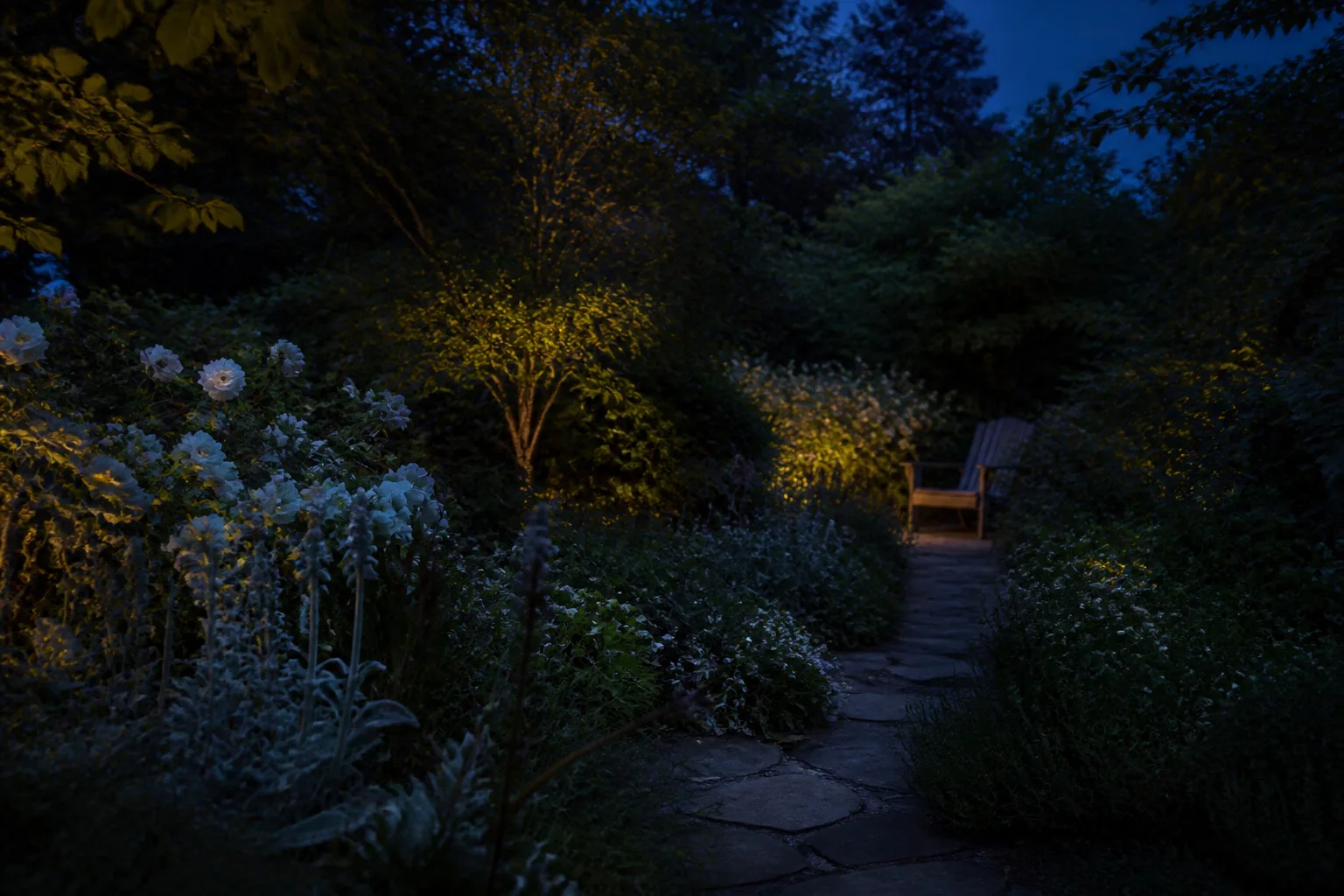
Pale flowers and silvery foliage can remain visually prominent as stronger colors become harder to distinguish. Designers of night gardens deliberately use whites, silvers and pale colors for exactly that reason. You don’t need an entirely white garden to use the idea. Actually, I’d rather you didn’t.
A few repeated pale elements may be enough. White flowers near a path. Silver foliage among darker planting. A pale-flowering climber near the patio. A light-colored container that remains visible after everything around it softens into darkness.
The point isn’t to make the garden bright. It’s to give darkness something to work with.
Please don’t light the whole thing
This may be where nighttime gardens go most wrong. We spend years creating depth, shadow, texture and mystery, then install enough outdoor lighting to make the backyard resemble a car dealership. You need enough light to use a space safely. Steps should be visible. Paths should make sense. People should be able to find their wine without conducting a search-and-rescue operation.
But more light isn’t automatically better design. Sometimes one carefully illuminated tree is more compelling than twelve illuminated shrubs. Sometimes the dark part is part of the composition. Darkness hides boundaries. It creates depth. It lets one feature appear while another recedes.
And there’s an ecological reason to exercise some restraint too. Artificial light at night can disrupt nocturnal wildlife, including moths. Research and wildlife organizations have documented effects on nocturnal insects’ navigation, feeding, reproduction and pollination behavior.
If outdoor lighting is necessary, keep it low, direct it where it is actually needed, use lower-intensity warmer light, and turn it off when it isn’t being used. Motion sensors and timers can help too. That happens to be good design advice as well. Light the reason for the light. Not the entire zip code.
Meet the night shift
Bees and butterflies have excellent public relations. Moths somehow got sweaters and porch lights.
They deserve a better agent.
Many moths are active after dark and visit flowers for nectar, carrying pollen as they move between plants. Researchers are still learning how important nocturnal pollination is across different ecosystems, but moths can play a meaningful role that gardeners rarely get to see. And that’s the interesting part. Your garden doesn’t stop functioning because you went inside.
Something is still flying. Something is opening. Something is eating a leaf you were emotionally attached to. Something is pollinating something else. The night garden isn’t simply the daytime garden with the lights turned off. It’s habitat for an overlapping but different collection of visitors.
You don’t have to turn the yard into a wildlife preserve to acknowledge them. Leave some darkness. Grow a few nectar-rich or night-scented plants appropriate to your region. Avoid unnecessary pesticide use. And maybe stop assuming every caterpillar represents an act of war.
Design for where you actually are
Here’s perhaps the most useful idea in all of this. Stop thinking only in terms of garden beds. Think in terms of moments. Where do you stop? Where do you sit? Which path do you actually use? Where does someone stand while talking after dinner? Which window gets opened on a warm night? Where do you walk barefoot? Where do you pause?
Those places deserve the plants and sensory details that are best experienced up close. Put fragrance where you linger. Put texture where you’ll brush past it. Put subtle flowers where you’ll actually see them. Put sound where you’ll hear it. And put the spectacular plant where somebody can encounter it rather than where it happened to fit on planting day.
A fragrant plant at the forgotten edge of the property is landscaping. A fragrant plant beside your chair is an experience. That’s a small distinction with surprisingly large consequences.
Listen too
Night takes away visual information, which means you start noticing everything else. Leaves moving. Ornamental grasses rustling. Water. Insects. The neighbor doing something inexplicably violent with a trash can. Not all of this can or should be designed. That’s sort of the point.
A garden that succeeds only visually is leaving quite a lot on the table. Movement creates sound. Water changes the atmosphere of a patio. Aromatic foliage can release fragrance when it’s touched or brushed against. Gravel underfoot sounds different from smooth paving. You don’t need to turn the backyard into a sensory theme park. Just notice what’s already happening. Then decide whether you want more of it.
Some of the best parts won’t photograph well
We have become extremely good at designing things for pictures. Perfect borders. Perfect containers. Perfect outdoor kitchens. Everything captured from exactly the right angle during exactly the right 14 minutes before sunset. But some of the best qualities of a garden are almost impossible to photograph.
The smell of a flower carried across warm air. The sound of leaves moving when everything else has gone quiet. The temperature dropping after sunset. A moth appearing for five seconds and disappearing again. The way a familiar path feels completely different when you can’t see its ending. None of this cares whether the garden is Instagrammable. It requires you to actually be there.
And perhaps that’s the biggest difference between designing a garden for daylight and designing one for night. During the day, we’re very good at looking at a garden. At night, we’re more likely to sit in it.
Go outside after everyone clocks out
Don’t redesign anything yet.
Tonight, go outside. Leave the big lights off for a minute. Wait for your eyes to adjust. Walk through the garden you thought you knew.
Find the plant that disappears. Find the one that suddenly matters. Notice where darkness makes walking difficult and where darkness makes the garden better. Notice what you can smell before you can see it. Listen. Look for whatever has taken over after the bees went home.
Would I design anything differently if I cared as much about this garden at 9 p.m. as I do at noon?
Maybe the answer is no.
Maybe it’s one fragrant plant beside the patio. One pale flower repeated through a border. One unnecessary light switched off. One chair moved somewhere better.
That’s enough.
Because you may discover that your garden already has a second version. You’ve just been going inside before it starts.