Your Garden Needs Somewhere to Put the Hose
Water, tools, soil, and clippings need clear routes through a garden. Plan the working layer and the beautiful layer becomes easier to live with.

A garden can have a breathtaking planting plan and still make you furious every time the hose catches around a pot.
The working parts of a garden are not glamorous, but they decide whether ordinary care takes ten minutes or becomes a small domestic crisis. Water has to reach the plants. Tools need to live near the work. Bags of soil need a route in. Clippings need a route out. If none of that has a place, it ends up spread across the patio and leaning against the house.
A garden is easier to love when its chores have somewhere to happen.
Walk the hose before you draw the beds
Start at the water source and pull the hose to the farthest place that will need regular watering. Notice every corner it catches, every stair it crosses, and every piece of furniture you have to move. That path is part of the design whether you acknowledge it or not.
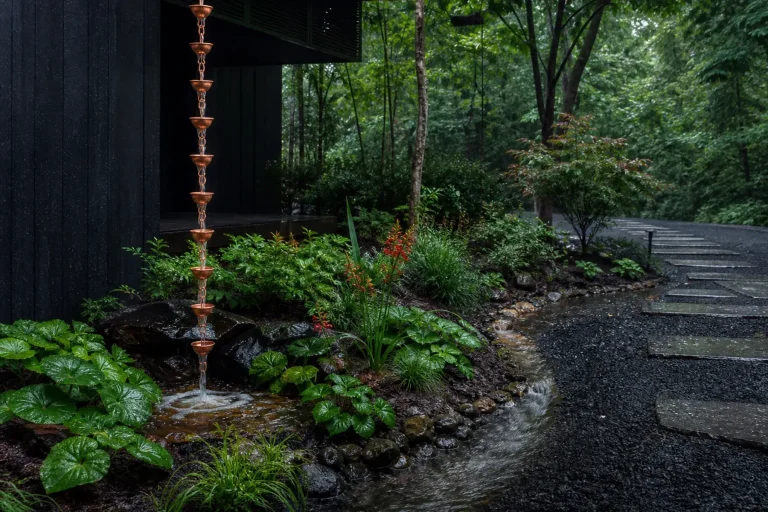
A hose should not need to travel through the dining area or across the main entrance. If one source cannot serve the space comfortably, consider whether a professionally installed additional connection, a properly designed drip system, or a different planting strategy would reduce the daily negotiation.
Penn State Extension recommends putting water where it is needed and notes that a wand with a shutoff valve can improve control. The useful design question comes one step earlier. Can you reach the plant without dragging the rest of the garden with you?
Give every recurring job a home
- Water
- A reachable source, a hose that returns easily, and a place where wet equipment can drain without staining the main view.
- Tools
- Secure storage close enough that putting a trowel away is easier than abandoning it on a table.
- Materials
- A route wide enough for soil, mulch, containers, and the largest object you regularly move.
- Waste
- A discreet place for clippings, fallen leaves, empty pots, and anything waiting for compost or collection.
University of Georgia Extension includes water access, tool storage, paths, and material delivery among the practical considerations of a garden site. Those needs do not disappear in a private yard. They simply become easier to ignore until you are carrying a full bag through a narrow gate.
Hide the work without making it difficult
Utility areas do not have to be ugly. They do have to remain accessible. A handsome screen, dark cabinet, covered bench, or small service court can hold the working layer of the garden without turning it into a display.
Do not bury the hose connection behind a shrub that will become six feet wide. Do not put the compost bin at the farthest possible point only because you do not want to see it. Do not choose a storage box that cannot open when the nearby plant reaches maturity.
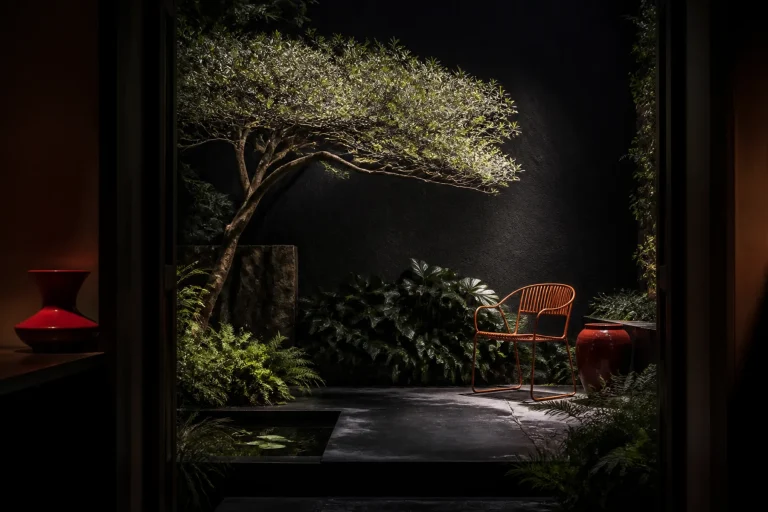
Screen the view, not the access. Use materials already present in the garden so the practical pieces feel intentional. A black hose on a dark reel, a brown storage cabinet near a fence, or a terracotta pot used to hold hand tools can disappear without pretending the work does not exist.
Make one service map
Draw the property in simple shapes. Add the water source, storage, bins, gates, stairs, narrow passages, and places where vehicles or deliveries can reach. Then draw the routes between them.
If the working route cuts through the place where people eat, sit, or enter, the layout is asking two activities to occupy the same space. Move the route, move the storage, or make the overlap deliberate enough that it can work.
The prettiest garden photograph never shows where the hose goes. Real life always does.